Collection of GST, Resolution of IGST , and Provision of Compensation to the States
Dr. Akhedan Charan
Additional Commissioner of State Tax
Indirect tax collection before the implementation of GST.
India follows a federal framework in which both the central government and the state governments possess the constitutional authority to impose taxes. In Chapter 1 of the book, we previously discussed that before the implementation of GST, the union government imposed Customs Duties, Union Excise Duties, CENVAT, Service Tax, and CST. Meanwhile, the state governments levied State Excise Duty, Stamp and Registration Fees, General Sales Tax, Taxes on Vehicles, Entertainment Tax, Tax on Goods and Passengers, Taxes and Duty on Electricity, and Taxes on Purchase of Sugarcane. According to the Department of Economic Affairs of the Government of India, the total budgeted indirect tax collection in the fiscal year 2015-2016 was ₹1,605,732 crore. The rate of tax collection has been steadily increasing since 2007-2008, with a growth rate of 14.6 percent. In 2015-2016, the growth rate reached 16.2 percent (Table 16.1).
Revenue from Taxes Subsumed under GST
The Thirteenth Finance Commission formed the Task Force on GST to determine the Revenue Neutral Rate (RNR) for the Goods and Services Tax (GST). To achieve this objective, they computed the revenue generated from the levies that were intended to be included in the Goods and Services Tax (GST). The group utilized the fiscal year 2007-2008 as the reference year for computing the RNR. Table 13.2 provides a detailed breakdown of the collections for central government. The commodities that are considered sinful are nevertheless subject to a twofold levy, which includes both the Central commodities and Services Tax (CGST) and central excise. In the fiscal year 2007-2008, the combined revenue generated from these central taxes, which includes revenue from petroleum and tobacco goods, amounted to 233,435 crores. The revenue generated from non-sin goods and services amounted to 157,733 crores. As excise duty still applies to commodities considered harmful or sinful, the Task Force only considered goods and services that are not considered harmful or sinful when calculating the Revenue Neutral Rate (RNR). The determined sum for the RNR was 157,733 crore.
The distribution of the collected by the state governments is presented in Table 13.3. In the fiscal year 2007-2008, the total revenue generated from EC taxes amounted to 118,356 crore. The total did not encompass the revenue generated from petroleum, alcohol, and tobacco items. The cumulative revenue generated from TF taxes amounted to 188,285 for the same time frame. The TF taxes did not encompass the collection of revenue from petroleum, alcohol, and tobacco items. The group believed that all the TF taxes should be included inside the SGST. Therefore, they utilized a total of 188,285 crore for the computation of RNR.
Source: The indirect taxation in India Yashwant Sinha , V. Shrivastav
Table 16.2 Revenue from Central Taxes Subsumed under GST for 2007-08
Source: Computed from the Report of Task Force on Goods and Services
Table 16.3 Revenue from State taxes subsumed under GST for 2007-08
Source: Computed from the Report of Task Force on Goods and Services.
GST Revenue for 2023-24
Gross Good and Services Tax (GST) revenue for March 2024 witnessed the second highest collection ever at ₹1.78 lakh crore, with a 11.5% year-on-year growth. This surge was driven by a significant rise in GST collection from domestic transactions at 17.6%. GST revenue net of refunds for March 2024 is ₹1.65 lakh crore which is growth of 18.4% over same period last year.
Strong Consistent Performance in FY 2023-24: FY 2023-24 marks a milestone with total gross GST collection of Rs. 20.18 lakh crore exceeding ₹20 lakh crore, a 11.7% increase compared to the previous year. The average monthly collection for this fiscal year stands at ₹1.68 lakh crore, surpassing the previous year’s average of ₹1.5 lakh crore. GST revenue net of refunds as of March 2024 for the current fiscal year is ₹18.01 lakh crore which is a growth of 13.4% over same period last year.
Positive Performance Across Components: Breakdown of March 2024 Collections:
Central Goods and Services Tax (CGST): ₹34,532 crore; State Goods and Services Tax (SGST): ₹43,746 crore; Integrated Goods and Services Tax (IGST): ₹87,947 crore, including ₹40,322 crore collected on imported goods;
Cess: ₹12,259 crore, including ₹996 crore collected on imported goods.
Similar positive trends are observed in the entire FY 2023-24 collections:
Central Goods and Services Tax (CGST): ₹3,75,710 crore; State Goods and Services Tax (SGST): ₹4,71,195 crore;
Integrated Goods and Services Tax (IGST): ₹10,26,790 crore, including ₹4,83,086 crore collected on imported goods;
Cess: ₹1,44,554 crore, including ₹11,915 crore collected on imported goods.
Inter-Governmental Settlement: In the month of March, 2024, the Central Government settled ₹43,264 crore to CGST and ₹37,704 crore to SGST from the IGST collected. This translates to a total revenue of ₹77,796 crore for CGST and ₹81,450 crore for SGST for March, 2024 after regular settlement. For the FY 2023-24, the central government settled ₹4,87,039 crore to CGST and
₹4,12,028 crore to SGST from the IGST collected.
The chart below shows trends in monthly gross GST revenues during the current year. Table-16.4 shows the state-wise figures of GST collected in each State during the month of March, 2024 as compared to March, 2023. Table-16.5 shows the state-wise figures of post settlement GST revenue of each State till the month of March, 2024.
Chart: Trends in GST Collection
Table 16.4: State-wise growth of GST Revenues during March, 20241
| State/UT | Mar-23 | Mar-24 | Growth (%) |
| Jammu and Kashmir | 477 | 601 | 26% |
| Himachal Pradesh | 739 | 852 | 15% |
| Punjab | 1,735 | 2,090 | 20% |
| Chandigarh | 202 | 238 | 18% |
| Uttarakhand | 1,523 | 1,730 | 14% |
| Haryana | 7,780 | 9,545 | 23% |
| Delhi | 4,840 | 5,820 | 20% |
| Rajasthan | 4,154 | 4,798 | 15% |
| Uttar Pradesh | 7,613 | 9,087 | 19% |
| Bihar | 1,744 | 1,991 | 14% |
| Sikkim | 262 | 303 | 16% |
| Arunachal Pradesh | 144 | 168 | 16% |
| Nagaland | 58 | 83 | 43% |
| Manipur | 65 | 69 | 6% |
| Mizoram | 70 | 50 | -29% |
| Tripura | 90 | 121 | 34% |
| Meghalaya | 202 | 213 | 6% |
| Assam | 1,280 | 1,543 | 21% |
| West Bengal | 5,092 | 5,473 | 7% |
| Jharkhand | 3,083 | 3,243 | 5% |
| Odisha | 4,749 | 5,109 | 8% |
| Chhattisgarh | 3,017 | 3,143 | 4% |
| Madhya Pradesh | 3,346 | 3,974 | 19% |
| Gujarat | 9,919 | 11,392 | 15% |
| Dadra and Nagar Haveli and Daman & Diu | 309 | 452 | 46% |
| Maharashtra | 22,695 | 27,688 | 22% |
| Karnataka | 10,360 | 13,014 | 26% |
| Goa | 515 | 565 | 10% |
| Lakshadweep | 3 | 2 | -18% |
| Kerala | 2,354 | 2,598 | 10% |
| Tamil Nadu | 9,245 | 11,017 | 19% |
| Puducherry | 204 | 221 | 9% |
| Andaman and Nicobar Islands | 37 | 32 | -14% |
| Telangana | 4,804 | 5,399 | 12% |
| Andhra Pradesh | 3,532 | 4,082 | 16% |
| Ladakh | 23 | 41 | 82% |
| Other Territory | 249 | 196 | -21% |
| Center Jurisdiction | 142 | 220 | 55% |
| Grand Total | 1,16,659 | 1,37,166 | 18% |
Source: Pib (id 2016802) 1 does not include GST on import of Goods
Allocation of Integrated Goods and Services Tax (IGST) Funds
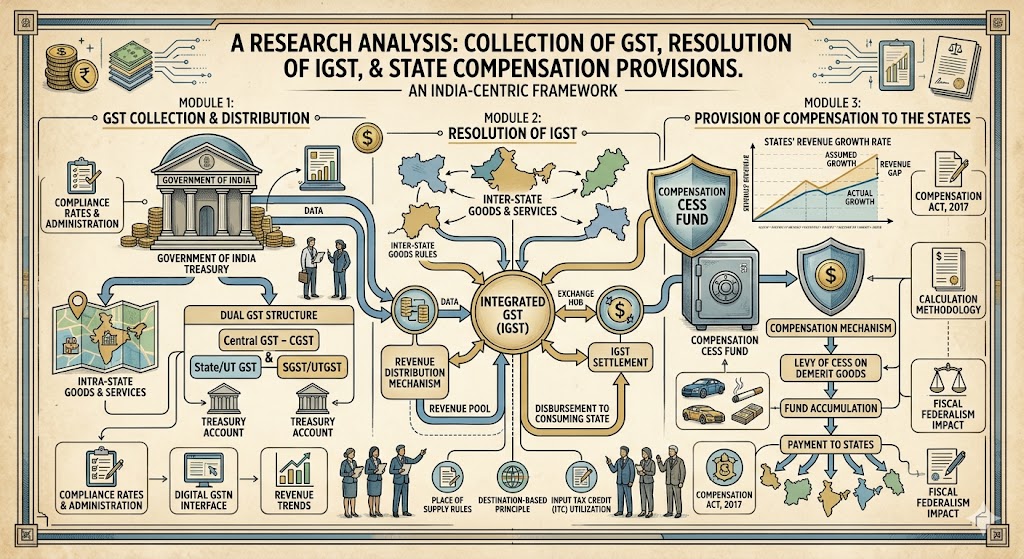
Inter-state supply of goods and services are subject to the imposition of IGST. This is valid in both scenarios of importing into India and exporting from India. The exports would be exempted from the Integrated Goods and Services Tax (IGST). The Integrated Goods and Services Tax (IGST) will be collected and imposed by the Government of India (GoI), and this tax will be divided between the central government and the state governments. The government preserves the data about the collection and allocation of IGST. The collection of Integrated Goods and Services Tax (IGST) is being shifted to Central Goods and Services Tax (CGST) and State Goods and Services Tax (SGST).
Resolution of IGST Funds for the fiscal year 2017-2018
The revenue generated by Integrated Goods and Services Tax (IGST) is being distributed among the central government and the state governments by the Parliament, based on the suggestions made by the Goods and Services Tax (GST) Council. In December 2017, the government paid 10,348 crores to the Central Goods and Services Tax (CGST) and 14,488 crore to the State Goods and Services Tax (SGST) from the Integrated Goods and Services Tax (IGST). In January 2018, the government made additional payments of 11,327 crore to CGST and 13,479 crore to SGST from IGST.
Resolution of IGST Funds for the fiscal year 2018-2019
The combined revenue generated by the central and state governments through the settlement process in April 2018 amounted to 32,493 crore for CGST and 40,257 crore for SGST.
In May 2018, the combined revenue earned by the union and state governments, following the usual settlement, amounted to 28,797 crore for CGST and 34,020 crore for SGST.
In June 2018, the combined revenue earned by the union and state governments through regular settlement was 31,645 crore for CGST and 36,683 crore for SGST. An additional interim settlement of ₹50,000 crore has been made by the government between the union and states. This settlement was an additional agreement following the preceding provisional settlement of 35,000 crore in February 2018.
The combined revenue generated by the central and state governments, after accounting for a provisional settlement of ₹12,000 crore in August 2018, amounted to ₹36,963 crore for CGST and ₹41,163 crore for SGST.
Gross Domestic Product (GDP) and Goods and Services Tax (GST) revenue collection for the month of April 2018
In September 2018, the combined revenue generated by the union and state governments amounted to 30,574 crore for CGST and 35,015 crore for SGST.
In October 2018, the government made payments of 17,490 crore to CGST and ₹15,107 crore to SGST from IGST. In addition, a total of ₹30,000 crore has been allocated from the remaining balance of Integrated Goods and Services Tax (IGST) on a provisional basis, with a 50:50 distribution between the central government and the state governments. The combined income generated by the union and state governments through regular settlement in October 2018 amounted to 48,954 crore for CGST and 52,934 crore for SGST.
In November 2018, the government allocated a total of 18,262 crore to the Central Goods and Services Tax (CGST) and 15,704 crore to the State Goods and Services Tax (SGST) from the Integrated Goods and Services Tax (IGST). The combined income generated by the central and state governments through regular settlement in November 2018 amounted to 35,073 crore for CGST and 38,774 crore for SGST.
In December 2018, the government allocated a sum of 18,409 crore to the Central Goods and Services Tax (CGST) and 14,793 crore to the State Goods and Services Tax (SGST) from the Integrated Goods and Services Tax (IGST). In addition, a total of 18,000 crore has been allocated from the remaining balance of Integrated Goods and Services Tax (IGST) on a provisional basis, with a 50:50 distribution between the central government and the states. Hence, the combined revenue generated by the central and state governments through regular settlement in December 2018 amounts to 43,851 crore for CGST and 46,252 crore for SGST.
In January 2019, the government allocated 18,344 crore to CGST and 14,677 crore to SGST from IGST. Hence, the combined revenue generated by the central and state governments through regular settlement in January 2019 amounted to 36,107 crore for CGST and 39,503 crore for SGST.
In February 2019, the government allocated 19,470 crore to CGST and 15,747 crore to SGST from IGST. Hence, the combined revenue generated by the central and state governments through regular settlement in February 2019 amounted to 37,095 crore for CGST and 39,939 crore for SGST.
In March 2019, the government allocated 17,261 crore to the Central Goods and Services Tax (CGST) and 13,689 crore to the State Goods and Services Tax (SGST) from the Integrated Goods and Services Tax (IGST). In addition, a total of 20,000 crore rupees has been allocated from the balance of Integrated Goods and Services Tax (IGST) on a provisional basis, with a 50:50 distribution between the central government and the state governments. Hence, the combined revenue generated by the central and state governments through regular settlement in March 2019 amounted to ₹47,614 crore for CGST and ₹51,209 crore for SGST.
Resolution of IGST Funds for the fiscal year 2019-2020
In April 2019, the combined revenue generated by the union and state governments was 20,370 crore for CGST and 15,975 crore for SGST, following a settlement. In addition, a total of ₹12,000 crore has been allocated from the remaining balance of Integrated Goods and Services Tax (IGST) on a provisional basis, with a 50:50 distribution between the central government and the state governments. Hence, the combined revenue generated by the central and state governments through regular settlement in April 2019 amounted to ₹47,533 crore for CGST and ₹50,776 crore for SGST.
In May 2019, the combined revenue earned by the union and state governments, following the usual settlement process, amounted to 18,098 crore for CGST and 14,438 crore for SGST. Hence, the combined revenue generated by the central and state governments through regular settlement in May 2019 amounted to 35,909 crore for CGST and 38,900 crore for SGST.
The government has allocated 18,169 crore to the Central Goods and Services Tax (CGST) and 13,613 crore to the State Goods and Services Tax (SGST) from the Integrated Goods and Services Tax (IGST) as part of the normal settlement. In June 2019, the combined revenue generated by the union and state governments, following the usual settlement, was 36,535 crore for CGST and 38,956 crore for SGST.
The government has disbursed 23,165 crore to the Central Goods and Services Tax (CGST) and 16,623 crore to the State Goods and Services Tax (SGST) from the Integrated Goods and Services Tax (IGST) as part of the routine settlement. In August 2019, the combined revenue earned by the union and state governments, following the usual settlement, amounted to 40,898 crore for CGST and 40,862 crore for SGST.
The government has disbursed a total of ₹21,131 crore to the Central Goods and Services Tax (CGST) and ₹15,121 crore to the State Goods and Services Tax (SGST) from the Integrated Goods and Services Tax (IGST) as part of the routine settlement process. In September 2019, the combined revenue generated by the union and state governments, following the usual settlement process, amounted to 37,761 crore for CGST and 37,719 crore for SGST.
The government has allocated 20,642 crore to the Central Goods and Services Tax (CGST) and 13,971 crore to the State Goods and Services Tax (SGST) from the Integrated Goods and Services Tax (IGST) as part of the normal settlement. In October 2019, the combined revenue earned by the union and state governments, following the usual settlement, amounted to 38,224 crore for CGST and 37,645 crore for SGST.
The government has disbursed ₹25,150 crore to the Central Goods and Services Tax (CGST) and ₹17,431 crore to the State Goods and Services Tax (SGST) from the Integrated Goods and Services Tax (IGST) as part of the routine settlement. In November 2019, the combined revenue earned by the union and state governments, following the usual settlement, was 44,742 crore for CGST and 44,576 crore for SGST.
Table-16.5 displays the state-wise post settlement GST revenue figures for each state up until March 2024.
Table-16.5: SGST & SGST portion of IGST settled to States/UTs April-March (Rs. in crore)
| Pre-Settlement SGST | Post-Settlement SGST | |||||
| State/UT | 2022-23 | 2023-24 | Growth | 2022-23 | 2023-24 | Growth |
| Jammu and Kashmir | 2,350 | 2,945 | 25% | 7,272 | 8,093 | 11% |
| Himachal Pradesh | 2,346 | 2,597 | 11% | 5,543 | 5,584 | 1% |
| Punjab | 7,660 | 8,406 | 10% | 19,422 | 22,106 | 14% |
| Chandigarh | 629 | 689 | 10% | 2,124 | 2,314 | 9% |
| Uttarakhand | 4,787 | 5,415 | 13% | 7,554 | 8,403 | 11% |
| Haryana | 18,143 | 20,334 | 12% | 30,952 | 34,901 | 13% |
| Delhi | 13,619 | 15,647 | 15% | 28,284 | 32,165 | 14% |
| Rajasthan | 15,636 | 17,531 | 12% | 35,014 | 39,140 | 12% |
| Uttar Pradesh | 27,366 | 32,534 | 19% | 66,052 | 76,649 | 16% |
| Bihar | 7,543 | 8,535 | 13% | 23,384 | 27,622 | 18% |
| Sikkim | 301 | 420 | 39% | 839 | 951 | 13% |
| Arunachal Pradesh | 494 | 628 | 27% | 1,623 | 1,902 | 17% |
| Nagaland | 228 | 307 | 35% | 964 | 1,057 | 10% |
| Manipur | 321 | 346 | 8% | 1,439 | 1,095 | -24% |
| Mizoram | 230 | 273 | 19% | 892 | 963 | 8% |
| Tripura | 435 | 512 | 18% | 1,463 | 1,583 | 8% |
| Meghalaya | 489 | 607 | 24% | 1,490 | 1,713 | 15% |
| Assam | 5,180 | 6,010 | 16% | 12,639 | 14,691 | 16% |
| West Bengal | 21,514 | 23,436 | 9% | 39,052 | 41,976 | 7% |
| Jharkhand | 7,813 | 8,840 | 13% | 11,490 | 12,456 | 8% |
| Odisha | 14,211 | 16,455 | 16% | 19,613 | 24,942 | 27% |
| Chhattisgarh | 7,489 | 8,175 | 9% | 11,417 | 13,895 | 22% |
| Madhya Pradesh | 10,937 | 13,072 | 20% | 27,825 | 33,800 | 21% |
| Gujarat | 37,802 | 42,371 | 12% | 58,009 | 64,002 | 10% |
| Dadra and Nagar Haveli and Daman and Diu | 637 | 661 | 4% | 1,183 | 1,083 | -8% |
| Maharashtra | 85,532 | 1,00,843 | 18% | 1,29,129 | 1,49,115 | 15% |
| Karnataka | 35,429 | 40,969 | 16% | 65,579 | 75,187 | 15% |
| Goa | 2,018 | 2,352 | 17% | 3,593 | 4,120 | 15% |
| Lakshadweep | 10 | 19 | 93% | 47 | 82 | 75% |
| Kerala | 12,311 | 13,967 | 13% | 29,188 | 30,873 | 6% |
| Tamil Nadu | 36,353 | 41,082 | 13% | 58,194 | 65,834 | 13% |
| Puducherry | 463 | 509 | 10% | 1,161 | 1,366 | 18% |
| Andaman and Nicobar Islands | 183 | 206 | 12% | 484 | 528 | 9% |
| Telangana | 16,877 | 20,012 | 19% | 38,008 | 40,650 | 7% |
| Andhra Pradesh | 12,542 | 14,008 | 12% | 28,589 | 31,606 | 11% |
| Ladakh | 171 | 250 | 46% | 517 | 653 | 26% |
| Other Territory | 201 | 231 | 15% | 721 | 1,123 | 56% |
| Grand Total | 4,10,251 | 4,71,195 | 15% | 7,70,747 | 8,74,223 | 13% |
Source: Pib (id 2016802)
The government has allocated 20,642 crore to CGST and 13,971 crore to SGST from IGST as part of the routine settlement. In October 2019, the combined revenue earned by the union and state governments, following the usual settlement, amounted to 38,224 crore for CGST and 37,645 crore for SGST.
State remuneration
Section 7 of the GST (Compensation to States) Act, 2017 includes a provision for providing compensation to states. According to the clause, the decrease in income resulting from the implementation of the GST system and the compensation for this decrease in income to the states will be estimated and paid out every two months for a period of five years. The purpose of providing compensation to states is to guarantee that their revenue remains at a minimum of 14% over the base year, which refers to the tax collection in 2015-2016. As part of the Goods and Services Tax (GST) system, a surcharge is being imposed on luxury, demerit, and sin goods in order to offset the revenue loss experienced by states as a result of the introduction of GST. The objective of GST compensation is to safeguard states from encountering abrupt budgetary challenges resulting from the implementation of GST. The central government disburses compensation to state governments on a biweekly basis.
Compensation for Goods and Services Tax (GST) for the fiscal year 2017-2018
The states’ revenue gap had a decline during the final eight months of the fiscal year 2017-2018. The mean revenue deficit across all states for the previous year was 17 percent. In order to address the disparity, the central government disbursed a total of 48,178 crores as GST compensation to the states for the fiscal year 2017-2018. The compensation for the months of July-August, September-October, November-December, January-February, and March for the year 2017-2018 may be found in Table 13.9, organized by state. According to Table 13.11, Karnataka received the highest amount of compensation from the central government, totaling ₹7,535 crore. Punjab followed with ₹4,618 crore, Gujarat with ₹4,277 crore, Bihar with ₹3,140 crore, and Maharashtra with ₹3,077 crore.
The central government disbursed a sum of 10,805 crore rupees as compensation to the states for the period of July-August 2017, 13,694 crore rupees for September-October 2017, 3,898 crore rupees for November-December 2017, 13,085 crore rupees for January-February 2018, and 6,696 crore rupees for the month of March 2018 on 29 May 2018.
Compensation for Goods and Services Tax (GST) for the financial year 2018-2019
As of November 2018, the central government allocated a total of 48,202 crores to provide GST compensation to the states for the fiscal year 2018-2019.
In July 2018, the central government allocated a sum of 3,899 crore to compensate the states for the period of April-May 2018. In August 2018, an amount of 14,930 crore was released for the months of June-July 2018. In November 2018, a total of 11,922 crore was provided for the period of August-September 2018. Additionally, 17,451 crore was allocated for the months of October-November 2018, and 18,934 crore was released for the period of February-March 2019.
Compensation for Goods and Services Tax (GST) for the fiscal year 2019-2020
The central government has disbursed 17,789 crores to the states as GST compensation for the months of April-May 2019, 27,955 crore for the months of June-July 2019, and 35,29830 crore for the months of August-September 2019.
It has been over two years since the implementation of the GST regime. An examination of GST collections reported in the Economic Times reveals that currently just three states – Mizoram, Manipur, and Arunachal Pradesh – have generated excess GST revenue compared to the average monthly earnings they were expected to achieve. 31 Therefore, they have ensured that the center is exempt from compensating them for any losses. However, six states – Bihar, Punjab, Himachal Pradesh, Jammu and Kashmir, Uttarakhand, and Puducherry – have a deficit ranging from 0 to 43 percent. The average GST revenue of the country from August 2017 to June 2018 exhibited a deficit of 13 percent.
Disbursement of GST compensation to States during the COVID-19 pandemic
The States have already received GST compensation for the financial years 2017-18, 2018-19, and 2019-20, in accordance with the GST (Compensation to States) Act, 2017. The aforementioned statement was made by Shri Pankaj Chaudhary, the Union Minister of State for Finance, in a written response to a query in the Rajya Sabha today.
The Minister additionally declared that the economic repercussions of the pandemic have resulted in an increased need for compensation due to reduced GST collection, as well as a decrease in the collection of GST compensation cess. The Centre disbursed ₹ 17,000 crore on 03.11.2021 from the Compensation Fund to provide GST compensation to the States. The information on the compensation provided to States/ UTs under the Goods and Services Tax (GST) is available in Table 13.6. The Minister indicated that an amount of ₹ 1,13,464 crore was provided to States/ UTs with legislature as GST compensation. This was done to partially fulfill the compensation required for the period of April 2020 to March 2021. The reason for this additional compensation was that the money available in the GST Compensation Fund was insufficient to cover the entire compensation need.
Providing more information, the Minister clarified that the problem of insufficient collection of cess for the Compensation Fund and the resulting GST compensation to States/UTs, caused by the economic consequences of the pandemic, has been discussed in the 41st, 42nd, and 43rd meetings of the GST council. The GST Council has decided to grant ₹1.1 lakh crore for the fiscal year 2020-21 and ₹1.59 lakh crore for the fiscal year 2021-22 to States/UTs as a back-to-back loan. This loan is intended to help the States/UTs fulfill their financial needs resulting from a shortage in GST compensation. The release of this specific sum of money has been strategically allocated at the beginning of the financial year in order to facilitate the States/Union Territories in carrying out their capital expenditures. Furthermore, the Centre has begun disbursing the regular GST compensation to States to compensate for the deficit in GST revenue, based on the available funds in the Compensation Fund.
According to the Minister, there is a pending GST compensation of ₹ 37,134 crore for the period April 2020 to March 2021 and ₹ 14,664 crore for April to September 2021, considering the GST compensation released from the Compensation Fund and the back-to-back loan released in FY 2020-21 and FY 2021-22, based on provisional figures. The government is dedicated to providing the complete GST Compensation to the States/UTs in accordance with the GST (Compensation to States) Act, 2017. This will be done by extending the imposition of Compensation cess beyond the initial 5 years. The purpose is to cover the shortfall in GST revenue and repay the loan obtained through the special window scheme.
The Minister responded to the proposal to extend GST compensation beyond 2022 by referring to Section 18 of the Constitution (One Hundred and First Amendment) Act, 2016. According to this section, Parliament is required to pass a law, based on the recommendation of the Goods and Services Tax Council, to provide compensation to the States for any revenue loss resulting from the implementation of the goods and services tax. This compensation is mandated for a period of five years from the date of GST implementation. During the transition phase, the revenue of the States is safeguarded at a rate of 14% each year over the revenue of the base year, which is 2015-16. The Central Government is dedicated to provide GST compensation to States/UTs for a period of 5 years in accordance with the Constitutional provision.
Table 13.6 Details of GST compensation released to States/ UTs on 03.11.2021
| S. No. | Name of State/UT | Amount (Rs. In crore) |
| (1) | (2) | (3) |
| 1 | Andhra Pradesh | 543 |
| 2 | Assam | 160 |
| 3 | Bihar | 342 |
| 4 | Chhattisgarh | 274 |
| 5 | Delhi | 1155 |
| 6 | Goa | 163 |
| 7 | Gujarat | 1428 |
| 8 | Haryana | 518 |
| 9 | Himachal Pradesh | 178 |
| 10 | J & K | 168 |
| 11 | Jharkhand | 264 |
| 12 | Karnataka | 1603 |
| 13 | Kerala | 674 |
| 14 | Madhya Pradesh | 542 |
| 15 | Maharashtra | 3054 |
| 16 | Meghalaya | 28 |
| 17 | Odisha | 286 |
| 18 | Puducherry | 61 |
| 19 | Punjab | 835 |
| 20 | Rajasthan | 653 |
| 21 | Tamil Nadu | 1314 |
| 22 | Telangana | 279 |
| 23 | Tripura | 17 |
| 24 | Uttar Pradesh | 1417 |
| 25 | Uttarakhand | 270 |
| 26 | West Bengal | 772 |
| Total | 17000* |
* Revenue collected by State of Arunachal Pradesh, Manipur, Mizoram, Nagaland and Sikkim is more than the revenue protected as per GST (Compensation to States) Act, 2017. Therefore, no GST compensation is admissible to these States.
Table 13.7 Details of GST Compensation released to States/ UTs for the year
Source: Computed from PIB, GOI, Finance dept.