Role of Empowered Committee Shaping Taxation
Dr. Akhedan Charan
Additional Commissioner of State Tax
Under the leadership of Inder Kumar Gujral, the United Front coalition government was operating at the center of the country, with the assistance of the Indian National Congress from the outside. The coalition consisted of fourteen different parties. On the 28th of November in 1997, the minority coalition administration was rendered ineffective. A decision to dismantle the government of the United Front was reached by the Congress Working Committee with complete consensus. I. K. Gujral received a letter from the General Secretary of Congress Oscar Fernandes, which informed him of the withdrawal of support. The letter was delivered to his residence. President Gujral received the resignation letter that Prime Minister Gujral had presented. Sitaram Kesri, who was serving as President of the Congress at the time, expressed his desire to establish a Congress government at the center of the centre and even wrote a letter to the President to assert his claim. He said, “We are certain that if we are given the opportunity, we will be able to demonstrate that we have the majority on the floor of the house.” Nevertheless, on December 4, 1997, President K. R. Narayanan dissolved Parliament and asked for new elections to be held. Atal Bihari Vajpayee was appointed Prime Minister on March 19, 1998, as a result of the post-election manoeuvring that resulted in the National Democratic Alliance (NDA) led by the Bharatiya Janata Party (BJP) gaining a working majority of 265 seats. And he appointed Yashwant Sinha to the position of minister of finance. Regarding the matter of taxation, Yashwant Sinha’s primary objective was to implement CENVAT and, ultimately, VAT, in accordance with the recommendations made by the L. K. Jha Committee in the year 1976.
Indirect tax reform was something that the government was pushing for a good reason. The issue of multiple taxes was a challenge that was faced by both the sector and the customers. A cascade effect was also produced by these. At the end of the day, these levies were the cause of tax evasion and a loss of money for the government. The new tax system, known as value-added tax (VAT), had already been implemented in a number of nations across Asia and the rest of the world. Additionally, India had taken a step in this direction by implementing the Modified Value-Added Tax (MODVAT) on a number of different goods.
In the month of October in the year 1999, Yashwant Sinha convened a gathering of the chief ministers of all of the states in the country. He was successful in convincing Jyoti Basu, the chief minister of West Bengal, to take the lead in coordinating the group of chief ministers about the proposed new tax, which Basu agreed to consider. In the history of the nation, Basu was the only chief minister to have held the position for a continuous period of 23 years. The report that was produced by this group created the groundwork for the states to come together and find a common ground of agreement. It was a political manoeuvre that Yashwant Sinha considered to be strategic. The NDA government, which was led by the BJP, was one of the most vocal detractors of Basu. In addition to this, he held the status of being the country’s most senior and longest-serving chief minister. Additionally, he had a finance minister named Asim K. Dasgupta who was exceptionally qualified and who went on to become the convener and chairman of the EC.
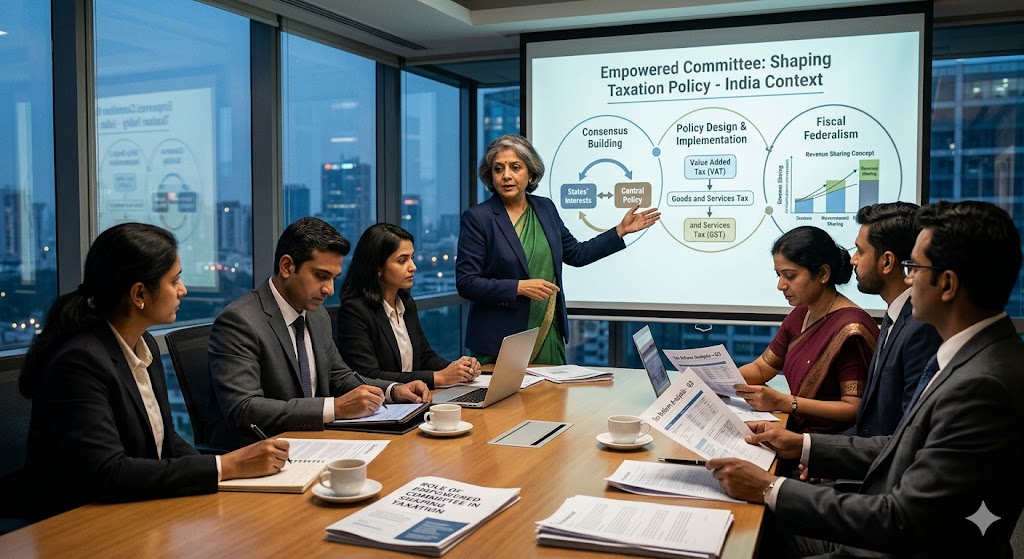
Later on, on July 17, 2000, the Standing Committee of Finance Ministers was transformed into the Empowered Committee of Finance Ministers on VAT. This was done in order to alleviate the chief ministers from the burden of being troubled on a regular basis. The state finance ministers entered the meeting prepared to make choices on behalf of their respective states, which was the definition of empowerment. Indeed, the Empowered Committee sped accelerated the process of implementing the value-added tax. The Empowered Committee was established with the participation of the ministers of finance from the states of Delhi, Gujarat, Karnataka, Maharashtra, Madhya Pradesh, Meghalaya, Punjab, Uttar Pradesh, and West Bengal. Later on, the members of the Empowered Committee were additionally declared to include the ministers of finance from the states of Assam, Jammu & Kashmir, Rajasthan, Jharkhand, and Tamil Nadu.
After some time had passed, on August 12, 2004[1], the Gol recreated the EC with the state finance and taxes ministers of each state serving as its members. The EC was subsequently registered as a trust on August 17, 2004, in accordance with the Societies Registration Act (XXI of 1860). Delhi Sachivalaya, was the location of the EC’s office. It was successful in meeting its administrative expenses and engaging in other activities thanks to the cash it received from both the central government and the state governments.
The establishment of the EC was done with the intention of monitoring the implementation of uniform floor rates of sales tax by states and union territories, monitoring the phasing out of incentive schemes that are based on sales tax, deciding milestones and methods for states to switch over to VAT[2], and monitoring reforms in the CST system that is currently in place in the country. As the principal architect of the value-added tax (VAT), Yashwant Sinha was of the opinion that additional joint procedures of this kind needed to be developed. It is only because we have had this equipment that we have been able to successfully implement the value-added tax. It would have been impossible for either the central government or the states to accomplish this on their own.
In every instance, the EC of state finance ministers was led by the minister of finance of a state that was dominated by an opposition party. It was Asim K. Dasgupta, a former professor of economics at Calcutta University, who served as the first Chairman of the EC. He was a person who provided legitimacy and respect to the EC. On the other hand, Dasgupta was forced to resign in 2010 due to the fact that he was no longer serving as the finance minister of West Bengal. At that time, he had finished approximately 80 percent of the work. In July 2011, he was succeeded by Sushil Kumar Modi, who was not only the deputy chief minister but also the finance minister of Bihar. The resignation of Sushil Kumar Modi from his position as Chairman took place on June 17, 2013. On the 22nd of July in 2013, Abdul Rahim Rather, who was serving as the minister of finance affairs for Jammu and Kashmir, succeeded Sushil Kumar Modi. On January 9, 2015, he resigned from his position. The position of finance minister in Kerala was taken over by K. M. Mani on March 20, 2015, succeeding Abdul Rahim. K. M. Mani, who had served as the finance minister of West Bengal until his resignation on November 10, 2015, was succeeded by Amit Mitra, who was appointed to the position on February 19, 2016. EC is currently led by him as its Chairman.
The EC held its appointments on a consistent basis. Representatives from the finance ministers of state governments, senior officials from the ministry of finance of the union government, finance secretaries, and commissioners of commercial tax from state governments were present at the sessions of the Empowered Committee. The Empowered Committee convened eleven times in the year 2005-2006, eleven times in the year 2006-2007, seven times in the year 2007-2008, eight times in the year 2008-2009, eleven times in the year 2009-2010, eight times in the year 2010-2011, seven times in the year 2011-2012, four times in the year 2012-2013, five times in the year 2013-2014, five times in the year 2014-2015, and five times in the year 2015-2016.4 EC also had its annual general meetings (AGMs) and published its annual reports on a yearly basis. So far, eleven annual reports have been made available to the public. The official website of the EC contains all of the reports that are available.
On January 17, 2005, the Empowered Committee presented a White Paper on VAT at the state level. On April 1, 2005, the State VAT was implemented; nonetheless, the EC was requested to continue working on the Goods and Services Tax (GST). On November 10, 2009, it presented the First Discussion Paper for the Goods and Services Tax. Eventually, on July 1, 2017, the Goods and Services Tax (GST) was implemented.
Because of the introduction of the GST Council, the Empowered Committee of State Finance Ministers has lost its relevance, and it has not been given any additional responsibilities and responsibilities. The meeting was scheduled for the 14th of December, 2017, with the purpose of discussing the revenue resources of the states as well as the best practices for administering resources that are not related to GST. “The Empowered Committee has neither been assigned new functions nor a fresh mandate has been given to it.” In the future, it might be possible for it to continue existing as a “trade union” of state finance ministers.
[1] Department of Revenue, ‘ Introduction (EC of State Government)
[2] EC of Finance Ministers, Annual Report 2005-06