Ancient Era Micro Perspective: Origin of Indian Indirect Taxes
Dr. Akhedan Charan
Additional Commissioner of State Tax
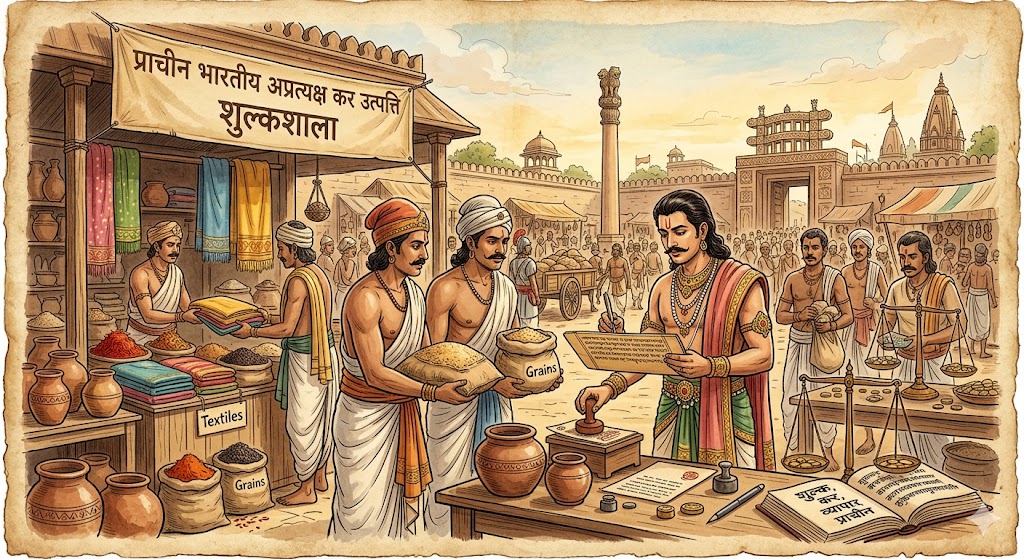
Taxation is a broad term that encompasses the various mechanisms through which governments, ranging from ancient monarchies to modern democracies, collect taxes from their citizens. However, during its evolution, its philosophies have shaped as well as name, nature, structure, scope, and rate have changed. Through the ages, competent authority has always been able to address the difficulties that every society has faced, such as those pertaining to defence, social welfare, infrastructure development, unexpected natural disasters and so on. The nature and breadth of tax systems have evolved to accommodate the more complex difficulties faced by modern communities around the globe.
In order to address these issues, the roles of governments has now grown substantially. In addition to maintain law and order and protecting the people from external aggression, the government often intervenes in economic operations in an effort to manage externalities and avert severe economic failure.
For breaking the vicious cycles of poverty, unemployment, illiteracy, lack of access to primary healthcare, income disparity and disproportionate distribution of resources a developing nation like India is to take on a number of additional responsibilities aimed at improving multifaceted development of society. So, in order to bring in enough money to cover the growing public expenditures without jeopardizing the legal framework of the FRBM Act plan, both direct and indirect taxes are necessary. Increases in both growth and stability can be facilitated by tax revenue. Concerningly, the tax-to-GDP ratio remains low. Reasons such as low tax revenue, tax avoidance, tax erosion and bureaucratic hurdles ensure that it remains stagnant. Because of its structure and character, in terms of cascading effects, ease of implementation and public understanding, convenience of collection, rates considering inequity and economy to compliance, indirect taxes play a significant role in raising government revenue. On this line despite the fact that GST would alleviate some of our issues with the indirect tax system, there is still a great deal to accomplish. The basic tax system, its values and ideologies in various periods of Indian history has been attempted to be understood in this study.
Overview
Taxes are mandatory fees imposed by a government to fund services provided for the general welfare. According to Mill, taxation is the fundamental requirement for the existence of governments. Taxation is a fundamental source of government revenue that enables the execution of essential actions in the best interest of the populace across generations. Hence, the contribution of individuals in the form of taxes holds eminent importance.
The origin of this governmental office can be traced back to the development of human society into political structures, leading to the establishment of the modern-day system. This was observed in ancient India that the Vedic scriptures, Epics, Smritis, Puranas, Arthashatra, and other literary texts and epigraphs from that era emphasized the crucial role of taxes in governance. A systematic taxation system was established during the Vedic period. The taxes were known by many names such as ‘bali’, ‘shulka’, ‘bhaga’, ‘udaja’, and ‘niraja’. The text of this period regularly references these taxes. The evolution of taxation has progressed gradually, transitioning from a voluntary system to a forced and regular one. This progression has been continued by numerous kings like as Manu, Kautilya, Gupta, Chol, Chera, Pandya, Mughal, and Maratha, each implementing their own forms of taxation with varying rates. The main source of government revenue was primarily taxes on agricultural produce.
However, over the time, the range of items subject to taxation increased. Currently, taxes are imposed on a wide range of goods and services, including the agricultural sector, which has experienced significant relief from taxation. Simultaneously, the scope and diversity of government functions also expand. The modern welfare state has numerous obligations towards its residents. Discharging tasks in a country like India, with its large population, becomes a highly challenging undertaking. The focus should be on providing a sustained living standard and improving human development indices, rather than only maintaining law and order, peace, and security. The government need a specific level of revenue in order to attain the desired level of economic growth, create jobs, and implement social welfare programs. Taxes serve as a significant source of money to enhance the overall well-being of a country by funding various policies and programs.
An Overview of Taxation in Ancient India
Taxation is a mandatory financial contribution made by residents to the state in order to enhance the overall well-being of the population. Taxation is an inherent component of all forms of governance in India, including monarchy, republic, and modern democratic systems. Taxation has been documented in ancient India through the descriptions provided in Manusmriti and Arthasastra. The current Indian tax system is derived from an ancient tax system that was founded on the principle of maximizing societal welfare. In Raghuvansham, Kalidas eloquently praised King Dalip-
“He collected taxes from his subjects solely for their benefit, similar to how the Sun absorbs moisture from the Earth and returns it in abundance.”
The ancient scholar recommended to the king that taxes should be based on the subjects’ income and expenses. They are aware of the detrimental impact of excessive taxation, which is why they proposed to the monarch that neither a high tax rate, which we now recognize as the Laffer Curve, nor complete tax exemption should be imposed. This issue is no longer relevant in the present tax system.
In ancient India, there was a widespread agreement that taxes should be levied in a way that minimizes the negative impact on individuals. In the Shantiparva of the Mahabharata (XII 88, 7-8), it is stated that the king should collect taxes from the state in a way similar to how bees gather honey from flowers without causing harm.
Kautilya’s taxation concept prioritized two fundamental principles:
- Equity
- justice
The wealthy were subject to greater tax rates in comparison to the impoverished. The passage also stated that taxes should be imposed at the appropriate time, location, and manner, and collected in a manner that is as satisfying as a calf nursing from its mother’s udders.
The fundamental principle of contemporary tax administration, as stated in Manusmriti, is to structure the collection of taxes in a way that minimizes the burden on the taxpayer. A regulation was established mandating that merchants and craftsmen contribute one-fifth (20%) of their goods in silver and gold, while farmers were required to contribute one-sixth (~16.5%), one-eighth (~12.5%), or one-tenth (10%) of their harvest, depending on their individual circumstances.
Kautilya, a prominent political economist in ancient India, provided a comprehensive account of the tax administration system during the Mauryan period. The tax structure in India now bears some resemblance to the Bhartiya Tax Structure that of the third century BCE.
The Arthasastra specified that each tax was distinct and there was no room for capriciousness. The tax collectors established the timetable for each payment, with the specific time, method, and amount all predetermined, similar to a modern and advanced tax system. Taxes were determined as a predetermined proportion of the overall produce, specifically 1/6th or 16.5%, in the form of land revenue. Import and export levies were calculated based on the value of the goods. The customs tariffs imposed on imported items amounted to around 20% of their whole worth. Furthermore, tolls, road cess, ferry taxes, and other levies were all established at specific rates.
The taxation system was user-friendly, as the state provided many reliefs to the common public during challenging times. In Arthasastra, Kautilya proposed that in times of disaster such as war, famine, or floods, the taxation system should be intensified and the king should have the authority to raise war loans. During times of emergency, it is possible to increase the land revenue from one-sixth to one-fourth. Individuals involved in commerce were required to make substantial contributions towards war operations.
Significant development over the course of time can be narrated as below:
The Vedic The Maurya The Gupta
- The Vedic Period lasted from 1500 to 500 BCE. The Vedic period refers to the specific era in Indian history when the Vedas, the ancient texts of Hinduism, were writtenThe vast majority of taxes were collected in the form of tangible goods, such as cereals and animals. Despite the fact that there were no well-documented indirect taxes, it was normal practice to make offerings and present tributes to the kings.
- The Mauryan Period lasted from 322 to 185 BCE. During the reign of Emperor Ashoka more organized taxatoin system was put into place. The book known as Arthashastra, which was written by Kautilya (Chanakya), provides a description of a number of different sorts of taxes, including indirect taxes on trade and goods. The customs duties that were imposed on commerce and transportation were substantial. Taxes were paid by merchants based on the value of the items that they traded.
3. The Gupta period following the Mauryan lasted from approximately 320 to 550 CE. Although land revenue was the most important source of revenue, indirect taxes on trade and production also played a considerable role.
Versatile Key definitions and meaning of Tax varied time to time
During Vedic Age Tax, sometimes referred to as Sukla (tax), was the portion of the buyer and seller’s payment that the king used to receive. Taxes on goods have been imposed on a variety of goods since the Vedic time. The criteria for fair taxation are outlined in verses 7.127 to 7.137 of the Manusmriti. An indirect tax referred to a tax that was collected by a middleman, such as a retail business, from the individual who ultimately paid the economic cost of the tax, such as the client. An indirect tax was a type of tax that could be transferred by the taxpayer to another individual or entity.
An indirect tax could result in a higher price for a good, causing consumers to effectively bear the burden of the tax by paying more for the products. Shri K. B. Sarkar, in his book Public Finance in Vedic India, praises the taxing system in Vedic India, stating that the majority of levies in this period were remarkably efficient in generating revenue. The inclusion of both direct and indirect taxes ensured flexibility in the tax system, while direct taxes were given greater importance. The tax structure was comprehensive and encompassed a wide range of individuals. The taxes exhibited a diverse range, which accurately mirrored the complex composition of the population.
Manu’s “Smrti” contains references to various tax measures. Manu asserted that the king had the authority to impose taxes on his subjects, as long as they were in accordance with the Sastras, which denotes their validity. He recommended that taxes should not, under any circumstances, impose difficulty on the individual for whom they were intended and from whom they were collected.
The Kautilya’s Arthasastra provides a well-organized and methodical methodology to impose and gather taxes for the state treasury. Regarding tax-related matters, his suggestions were an optimal combination of both direct and indirect taxes. During this period, the collection of land revenue served as a significant source of income for the State treasury. In addition, throughout this period, there was a prevalence of various forms of taxation like as water taxes, octroi duties, toll taxes, and customs duties. Taxes were levied on forest produce as well as on mining activities involving metals, among other things.
Chanakya’s aphorism in the Arthasastra, “Koshamoolo danda,” emphasizes the crucial role of the treasury and its inflows as the foundation of a government’s power. Undoubtedly, the Sanskrit term “danda,” which signifies the sceptre, is the tangible embodiment of a government’s essence, awareness, and moral principles. As to the Arthasastra of Kautilya, the crown had sovereignty over the lands and imposed different types of taxes on them. “The produce obtained from the portion of land owned by the government, known as crown lands (Sita), is subject to payment to the government (bhaga). Additionally, there are religious taxes (bali) and taxes that are paid in currency (Kara).”
The king possessed the ultimate power to impose and gather taxes from the individuals under his rule, in various forms. The objective of this was to obtain a portion of the agricultural yield generated from the area over which the king held supreme authority. The chief received voluntary offerings from the people, which are known as Bali. The items included under rashtra are produce from crown-lands, tithe, tributes on share of offerings (Bali), merchants, superintendent of rieveries, ferries, boats and ships, towns, pasture fields, road-cess, and ropes to bound thieves.
The term “kara” has a specific meaning as employed by Kautilya. According to Shaft, it refers to the annual tax paid during specific months such as Bhadrapada and Vasanta. However, the Arthasastra text by Kslrasvamin defines it as a fee on all movable and immovable items. Therefore, it can be inferred that kara was a regularly imposed general property tax.
The royal treasury received income from various sources such as forts (durga), rural areas (rashtra), mining (khani), structures and gardens (setu), woodlands (vana), herds of cattle (vraja), and road tolls (yanikpatha).The following taxes are included under the head: Tolls, fines, weights and measures, town-clerk, superintendent of coinage, of seals and pass-ports, liquor, slaughter of animals, manufacture of threads, oils, ghee, sugar, state goldsmith, ware-house of merchandise, the prostitute, gambling, building sites, lease, the corporation of artisans, and handi-crafts-men, superintendents of gods, gate-tax (custom or entertainments), and foreigners (bahirikas).
Sita: Consisting of several types of crops brought by the agriculture Supervisor.
Bhaga: Bhaga referred to the tax imposed on agricultural crops, amounting to one-sixth of the whole yield.
Bali: The Aryanas were the initial group of individuals who developed a taxing system under their king known as the Rajan. The Rigveda states that the Rajan would receive his earnings in the shape of Bali. The main source of income during the Vedic period was Bali. Taxation, referred to as ‘bali’ in the pre-Vedic period and later as ‘rajkar’, was considered a significant means of generating revenue for the state. Kara:
Vivita: a tax imposed on agricultural land used for grazing livestock. This phrase refers to the payment of fees collected by the Vivitadhyaksa for the utilization of pastures by the royal authorities. The tithe, or a portion of agricultural yield, serves as a royal tax that is referenced in all Dharmasastras. This practice is deemed legitimate based on the premise that the king holds true ownership of the land.
Rajju: Rajju refers to the cess or fee that is required to be paid for the purpose of settlement.
Chora rajju: A form of taxation imposed by local authorities or the police for maintaining law and order.
Vyaaji – a form of sales tax.
Atyaya refers to the penalty imposed for the infringement of a governmental monopoly.
Tax levied on entertainment activities can be viewed in light of various legendary Granths. Kautilya implemented a substantial tariff on imported luxury goods. According to the Dharmasūtras and Dharmaśāstras, it was the specific responsibility of the king to levy three types of taxes:
- Emergency tax (Praņaya),
- Celebration tax (Utsanga),
- War tax (Senābhakta).
There are taxes imposed on lottery, betting, and gambling activities.
The state imposed a gambling tax on the winnings of those who participated in gambling at state-maintained gambling establishments. The tax amounted to 5% of the stakes won and was required to be paid by the winner.
Service Tax
According to Manusmriti 7/128, the king should determine taxes in his kingdom in a manner that ensures both himself and the workers (such as traders and farmers) attain satisfactory outcomes. According to Manu, the Vedic scholar and legislator, traders and artisans were required to contribute 20% of their profits in silver and gold. On the other hand, agriculturists were expected to pay 16%, 12.5%, or 10% of their produce, depending on their individual circumstances.
There was an indirect tax imposed on the utilization of water from the reservoir Setu. According to Sankalia, the usage of rivers and similar water sources should either be exempt from taxation or people who rely on them for their livelihood should contribute to the King. The situation mentioned pertains to the rules of Yaj and Narada.
According to Vedic tradition, a merchant who entered a kingdom with his products was required to give a fitting present to the king as a customs charge. Over time, this practice evolved and became known as Customs Duty. This is levied on imports and occasionally on exports as well. The abbreviation “rccmindore” does not provide enough context to determine its meaning. A 5% profit margin will be applied to domestic items, while a 10% profit margin will be applied to imported goods. Severe penalties are imposed for surpassing these restrictions.
Arthasastra outlines many additional charges, surcharges, and levies to generate more cash.
The Arthasastra outlines many additional taxes, fees, and surcharges to generate extra money. In addition, regular fees and service charges are imposed. However, the tax rate for most economic activities is set at 16%. Given the current policy discussions on reforming indirect taxation, specifically the tax on production and sales, it would be logical to adopt Kautilya’s recommended rate of 16% as the Goods and Services Tax (GST) rate.
The significant increase in the rate of cow tax from 2% in Manusmriti to 12% in Sukraniti (800 AD) is a topic worthy of discussion
In nutshellthe practice of levying taxes on products and services in India has been in various forms since ancient Vedic times. The GST is facilitated to be highly effective within the context of the Vedic indirect taxation regime. In the Raghuvansha, Kalidasa describes King Dileepa as someone who collected taxes from his subjects solely for the benefit of the people, similar to how the Sun absorbs rain from the Earth and returns it in abundance.
Therefore, the implementation of GST serves as a transformative tactic. In the current economic landscape, the Goods and Services Tax (GST) plays a crucial role in consolidating the fiscal resources of a nation. In recent years, the Goods and Services Tax (GST) has gained significant importance in the economic and fiscal landscape of our nation. It currently plays a vital role in generating tax income for India. Therefore, the implementation of GST is expected to bring about a significant positive change for India. The implementation of GST is anticipated to be a pivotal change in stimulating economic growth.